
Art
Intent Statement
At Meadowhead Juniors, our KS2 art curriculum aims to inspire, challenge and empower pupils to express themselves creatively while developing a secure understanding of key artistic concepts and techniques. Through the Kapow Primary scheme of work, we ensure that drawing, painting and sculpture are taught progressively and coherently so that pupils:
-
Build confidence in their artistic abilities and develop a sense of personal expression.
-
Acquire and refine a broad range of practical skills across the key art disciplines.
-
Understand how artists, craft makers and designers across cultures and time periods influence artistic styles, processes and meanings.
-
Learn to think critically, evaluate their own work and appreciate the creative achievements of others.
-
Develop resilience, curiosity and a willingness to experiment through a structured yet creative curriculum.
National Curriculum Context
Our curriculum aligns fully with the KS2 National Curriculum for Art and Design, which requires pupils to develop their techniques and improve their mastery of art and design through drawing, painting and sculpture. Pupils are expected to use sketchbooks effectively to record observations, explore ideas and revisit and refine their work. They also learn about great artists, architects and designers in history, building cultural understanding and artistic appreciation. Kapow’s progressive structure ensures pupils meet and exceed these statutory requirements by providing rich opportunities to experiment with materials, study influential artists and create purposeful, original artwork.
The overarching intent is to nurture pupils’ creativity, support their wellbeing, and equip them with transferable skills in observation, problem-solving and communication.
Implementation
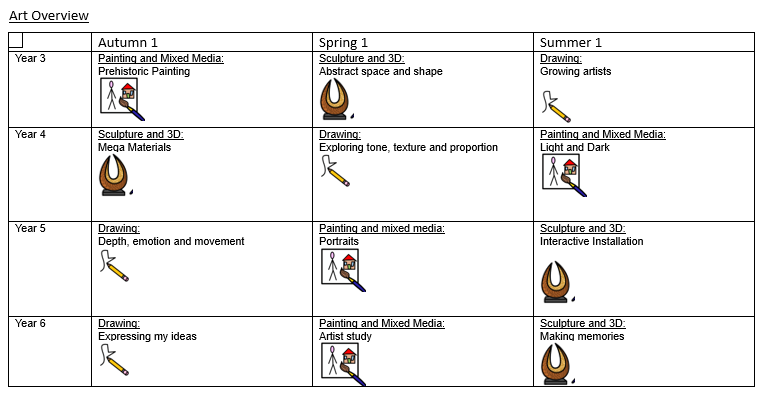
Our curriculum is implemented through the Kapow Primary scheme, which provides a clear, progressive structure for the teaching of drawing, painting and sculpture in KS2. Teachers deliver art lessons weekly, with units designed to build on prior KS1 learning and deepen understanding over time.
Drawing
-
Pupils explore line, tone, texture, proportion and perspective using a variety of media such as graphite, charcoal, ink and pastels.
-
Sketchbooks are used consistently to practise techniques, experiment with ideas and evaluate progress.
-
Units introduce pupils to a range of illustrators and artists to provide inspiration and context.
Painting
-
Teaching develops pupils’ understanding of colour theory, colour mixing, brush control and composition through the use of watercolours, acrylics and mixed media.
-
Guided activities help pupils refine key techniques, while open-ended tasks enable them to make creative choices and develop their own visual style.
-
Pupils study artworks from different cultures and eras, analysing how colour, shape and form convey mood and meaning.
Sculpture
-
Pupils work with materials such as clay, wire, modroc, card and found objects to create three-dimensional forms.
-
They learn and apply techniques including modelling, carving, joining and constructing armatures.
-
Projects often connect with wider curriculum themes, strengthening cross-curricular understanding and creativity.
Across all disciplines:
-
Key vocabulary and artistic terminology are taught explicitly and revisited to secure understanding.
-
Assessment is ongoing through sketchbook evidence, teacher observation, peer discussion and final outcomes.
-
Kapow’s structured lesson guidance, high-quality resources and video modelling support teacher confidence and ensure consistency across classes.
Impact
By the end of KS2, pupils will:
-
Demonstrate confidence and increasing proficiency in drawing, painting and sculptural techniques.
-
Produce artwork that shows clear progression, from initial explorations to refined outcomes, using sketchbooks effectively throughout the process.
-
Use artistic vocabulary with accuracy to describe techniques, processes and the work of artists.
-
Show an ability to experiment, take creative risks and evaluate their own and others’ work thoughtfully and constructively.
-
Understand the significance of art within different cultures, historical periods and contemporary contexts.
-
Leave KS2 well-prepared for the challenges of the KS3 art curriculum, with secure foundational skills, cultural awareness and a positive attitude towards artistic learning.
The impact of the curriculum is monitored through pupil voice, sketchbook scrutiny, lesson observations and displays of work. Evidence shows that pupils develop both technical skill and creative confidence, and that art supports their wellbeing, enjoyment and cultural understanding.